16 October 2026



You are mid-holiday. The group has already split the Airbnb, the airport taxi, and the first supermarket run. Then someone tries to log the restaurant bill and Splitwise stops them cold.
"You've reached your daily expense limit."
If that message has ever derailed your group's evening, you are not alone. Since late 2023, Splitwise's free tier has capped how many expenses users can add each day. For a group on a busy trip, that limit arrives faster than anyone expects.
This article explains exactly what the Splitwise daily expense limit is, why it catches so many groups off guard, and when switching to a shared money pot makes more sense than logging expenses after the fact.
Quick answer: Splitwise's free plan has a small daily cap on new expenses. Users report around 3 to 4 expenses a day, counted per account across all groups and friendships, with the allowance appearing to reset daily. Splitwise does not publish the exact number. Removing it requires a paid Splitwise Pro subscription for each account that wants it. For groups planning shared trips or events, a collect-first approach with a shared money pot sidesteps the problem entirely.
What Is Splitwise's Daily Expense Limit?
Splitwise introduced a daily expense cap for free users in late 2023. Before that, adding expenses was effectively unlimited, which is why long-time users felt the change so sharply.
Splitwise has never officially published the exact number, but its own Pro page confirms free accounts have a daily cap. Free users report a cap of around 3 to 4 new expenses a day, and say the allowance resets daily.
How the limit actually works
A few things catch groups off guard:
Users report the count is per account, not per group. If you are in two groups and add 2 expenses to each, you have used your daily allowance.
It appears to reset daily. If you hit the limit at 8pm on Friday, any expenses from the rest of that evening have to wait until your allowance resets.
Splitwise Pro removes it entirely. The paid subscription is billed per account, and prices vary by country. It lifts the cap and adds features like expense search and currency conversion.
A workaround exists, but it is clunky. You can ask another group member to add the expense and set you as the payer. It works, but it is not a practical solution when you are at a restaurant with eight people.
Why groups hit it faster than they expect
On a typical group trip, expenses stack up quickly. Consider a single active day:
Breakfast at a café
Train or metro tickets
Museum or activity entry
Lunch
Afternoon drinks
That is five expenses before dinner even starts. One person logging all of them hits the limit well before the evening begins. In practice, the limit suits individual use better than group trip dynamics where one person often acts as the de facto treasurer for the whole group.
The real frustration is not the limit itself. It is the timing. It tends to hit exactly when your group is trying to settle something important.
Splitwise Is a Tracker. That Is the Real Issue.
The daily limit is a symptom of a deeper design difference. Splitwise is built around tracking what has already been spent and settling up afterwards.
Someone pays. Someone logs it. The debt accumulates. Eventually, the group settles.
That model works well for simple situations: splitting a dinner bill, sharing a taxi, keeping track of who bought the last round. But it was never designed for groups managing a shared budget across multiple days or weeks.
The core problem with tracking after the fact
When you log expenses retrospectively, a few things tend to go wrong:
Someone always forgets to log something. Receipts get lost. Moments get missed.
One person carries the financial burden. The group organiser often fronts large costs like accommodation or transport, then spends days chasing repayments.
Debt creates awkwardness. Asking friends to pay you back is uncomfortable, even when everyone agrees upfront.
Disputes happen. "I thought that was included" is a sentence that ends friendships on group trips.
Splitwise handles these problems reasonably well for small groups and one-off situations. For a group managing shared expenses across a full trip or event, the track-and-settle model starts to show its limits, both literally and figuratively.
The real question is not "which app tracks expenses better?" It is "should your group be tracking expenses at all, or collecting money upfront instead?"
What Is a Shared Money Pot and How Is It Different?
A shared money pot works on the opposite principle to an expense tracker.
Instead of spending first and settling later, everyone contributes to a shared pot before anything gets spent. The money sits in one place. When something needs paying, the Money boss (the group's organiser) pays it with a payout from the pot. Potje is also launching a virtual Visa card for Money bosses. There is no debt to chase, no spreadsheet to maintain, and no limit on how many expenses you log, because there is nothing to log in the first place.
Potje is a shared money pot built for exactly this kind of group situation. Groups create a pot, set a goal amount, share a payment link, and everyone contributes their share upfront using Pay by Bank, Bancontact, iDEAL | Wero or SEPA bank transfer.
How a shared pot changes the dynamic
Expense tracker (e.g. Splitwise) | Shared money pot (e.g. Potje) | |
When money moves | After spending | Before spending |
Who carries the cost | One person fronts it | Everyone contributes upfront |
Debt | Accumulates over time | Does not exist |
Settlement | Settle up at the end | Spend directly from the pot |
Daily limit | Yes, on free plan | Not applicable |
Cost | Paid Pro subscription per account (prices vary by country) | €5/month per pot, shared by the group |
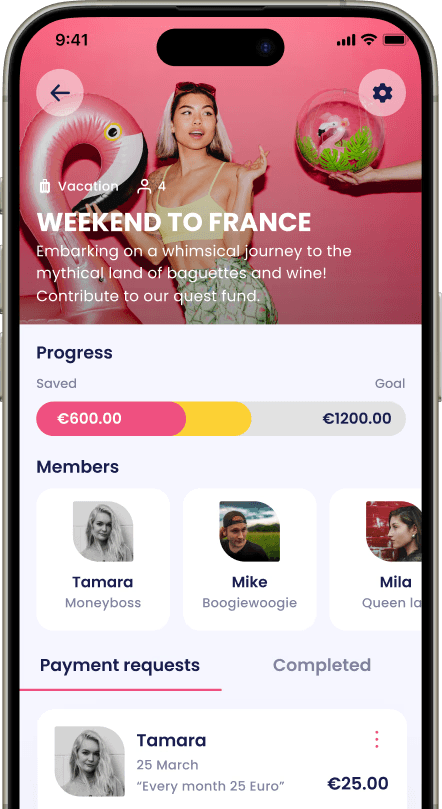
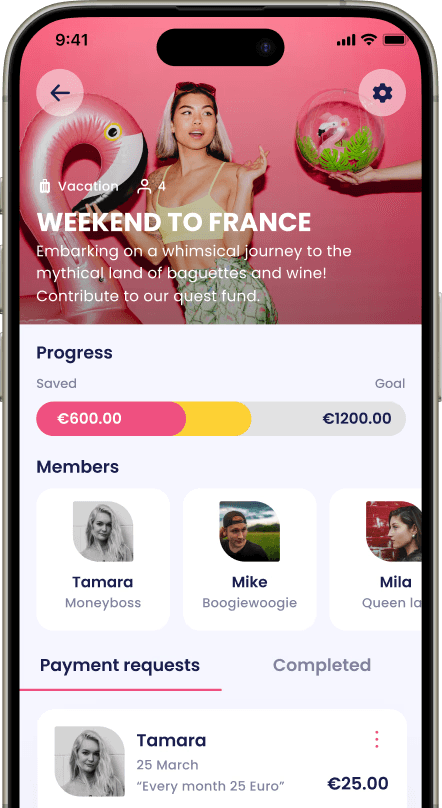
The practical difference is significant. When your group has a shared pot with €600 in it for a weekend away, nobody needs to log anything. The Money boss pays for the groceries, the activity and the accommodation with payouts from the pot. The money was already there.
For groups that regularly plan shared trips or events, this approach removes the friction entirely. You can also read our full comparison of group savings apps to see how different platforms approach the problem.
When Splitwise Still Makes Sense (and When It Does Not)
Splitwise is a really useful tool for certain situations. It is worth being honest about when each approach fits best.
When Splitwise works well
Ongoing flatmate or housemate expenses. Tracking who paid the electricity bill or bought the washing-up liquid over months is exactly what Splitwise was designed for.
Small, infrequent groups. If three friends go for dinner once a month and want to track who paid last time, a few expenses a day is more than enough.
Individual expense logging. Keeping track of your own spending across shared situations is a legitimate use case that the free tier handles fine.
When a shared pot is the better fit
Group trips with multiple daily transactions. A weekend city break, a ski holiday, a festival. The moment your group is logging more than a handful of expenses in a day, the free tier becomes an obstacle.
Events where one person organises the budget. Birthdays, stag and hen dos, team away days. The organiser should not have to front costs and chase repayments.
Groups where not everyone uses the same app. With Potje, the organiser invites everyone with a link, and people can join the pot or make a one-time contribution with their preferred method.
Any situation where debt feels uncomfortable. Some groups would rather pay upfront than owe each other money. A shared pot removes that dynamic entirely.
The honest answer is that these two tools solve different problems. Splitwise tracks what happened. A shared pot organises what is going to happen. For many groups, the second approach is the one they actually needed all along.
You can explore our guide comparing a digital pot, a joint account, and a split app to find the right fit for your group's situation.
How Potje Works for Groups
Potje is a shared money pot designed for groups throughout the EEA. The idea is simple: collect the money before you spend it, so nobody ends up out of pocket and nobody has to chase anyone afterwards. Potje sends automatic payment requests, follows up with late payers for you, and everyone sees the live balance.
Setting up a pot takes minutes
Create a pot. Name it and set a goal amount if you have one in mind.
Share the link. Send it to everyone in the group. They can join the pot or make a one-time contribution.
Everyone contributes. Members pay their share using Pay by Bank, Bancontact, iDEAL | Wero or SEPA bank transfer.
The organiser pays from the pot. When it is time to book the Airbnb or pay for the activity, the money is already there.
There is a step-by-step guide to setting up a group money pot if you want to walk through the process in detail.
What makes Potje different from other tools
First month free. New pots get the first month at no cost, so your group can try it before committing to anything.
Instant payouts of any amount. When you need to pay for something, the money moves immediately. There is no waiting for a minimum threshold.
No fee on partial payouts. If your group has collected €400 and wants to pay out €150 now and keep the rest, there is no charge for that.
Shared cost. Potje costs €5 per month per pot, deducted from the pot balance and shared by the group. With 10 people, that is €0.50 each. With 5 people, it is €1.00 each.
No expense logging required. Because the money is collected upfront, there is nothing to track. The daily limit problem simply does not exist.
The cost comparison is worth pausing on
Splitwise Pro is billed per account. Only the people who want Pro features, or who keep hitting the cap, need it. Potje costs €5 per month per pot, deducted from the pot balance and shared by the group.
For a group of five, the Potje fee works out at €1 each per month. And the underlying approach is better suited to collecting money upfront. For a closer look at both apps, read our full comparison of Potje and Splitwise.
Real Scenarios Where a Shared Pot Wins
Abstract comparisons are useful. Concrete examples are more useful.
Scenario 1: The group trip to Barcelona
Eight friends book a long weekend. The organiser creates a Potje pot for €1,200, covering accommodation and a shared activity budget. Everyone pays their €150 in the week before the trip.
On the trip itself, the organiser, as Money boss, pays the Airbnb from the pot, then covers the group dinner and the tour the same way, with payouts. Nobody logs anything. Nobody owes anyone anything. At the end of the weekend, there is €80 left, which the group votes to spend on the last night out.
Compare that to the Splitwise version: one person fronts the Airbnb, logs it, and then spends the next three days watching the balance grow while waiting for repayments. By day two, the expense limit kicks in and someone has to ask a friend to log the restaurant bill on their behalf.
Scenario 2: The birthday collection
Twelve colleagues want to get a meaningful gift for someone who is leaving. Someone creates a Potje pot, sets a goal of €240, and shares the link in the team chat. Everyone contributes €20 within a day or two. The organiser buys the gift directly from the pot.
No spreadsheet. No awkward "did you send your share?" messages. No one person out of pocket.
Scenario 3: The sports team kit fund
A local football team needs new kits. The treasurer creates a pot with a goal of €600 to collect within six weeks. The payment link goes in the group chat. Members contribute when they can, and the treasurer can see exactly who has paid and who has not, without sending a single reminder manually.
In all three scenarios, there are no expenses to log. The daily limit is irrelevant because the model is different from the ground up.
Frequently Asked Questions
What is Splitwise's daily expense limit?
Splitwise's free plan has a small daily cap on new expenses. Users report around 3 to 4 expenses a day, counted per account across all groups and friendships, with the allowance appearing to reset daily. Splitwise does not publish the exact number. The limit was introduced in late 2023. Splitwise Pro removes the limit entirely.
Can multiple people in a group hit the Splitwise limit on the same day?
Yes. The limit applies per account, not per group. So if five people in your group are all actively logging expenses on a trip, each of them can hit their own cap independently. On a busy travel day, your group could collectively run out of logging capacity across multiple accounts at the same time.
Can I work around the Splitwise daily expense limit for free?
Yes, but the workarounds are limited. You can ask another group member to add the expense and set you as the payer. You can also wait for the daily limit to reset. Neither solution is practical when your group is actively spending on a trip.
What is a shared money pot?
A shared money pot is a digital fund that a group contributes to before spending begins. Instead of tracking expenses after the fact and settling up later, everyone pays their share upfront. The Money boss pays costs with payouts from the pot. There is no debt and nothing to log.
How much does Potje cost?
Potje costs €5 per month per pot. The fee is deducted from the pot balance, so it is shared by everyone in the group. For a group of 5, that is €1.00 each per month. For a group of 10, it is €0.50 each. The first month is free.
Does Potje have a daily expense limit?
No. Because Potje is a shared money pot rather than an expense tracker, there are no expenses to log. The daily limit concept does not apply. Members contribute to the pot, and the Money boss pays costs from it with payouts.
What payment methods does Potje support?
Potje supports Pay by Bank, Bancontact, iDEAL | Wero, SEPA. Group members can contribute using whichever method suits them best.
Can I take money out of a Potje pot before it is full?
Yes. Potje offers instant payouts of any amount. There is no minimum threshold and no fee on partial payouts. If your group has collected €300 and needs to pay a deposit of €100, you can do that immediately.
Do all group members need to download the Potje app?
No. The organiser creates the pot in the app and invites everyone with a link. Other group members can join the pot or make a one-time contribution using their preferred payment method.
Is Potje available throughout the EEA?
Yes. Potje is available throughout the EEA (30+ countries) and supports the most widely used European payment methods, including iDEAL | Wero, Pay by Bank, Bancontact, SEPA bank transfer.
Stop Logging. Start Collecting.
If your group has hit Splitwise's daily expense limit, it is a signal worth paying attention to.
It is not just a technical inconvenience. It is a sign that your group is managing money in a way that creates friction. Someone is carrying costs. Someone is chasing repayments. Someone is trying to log a restaurant bill at 10pm and hitting a limit instead.
The better approach is to collect the money before you spend it.
Potje gives your group a shared money pot where everyone contributes upfront, payouts are instant, partial withdrawals are free, and the whole thing costs €5 per month per pot, paid from the pot balance. The first month is free.
No cap on how many expenses you log, no debt, and no awkward conversations at the end of the trip.
Start your pot, first month free, and see what group money feels like when it is organised from the start.

Social Accountability and Saving: The Missing Link to Financial Freedom
Ondersteuning voor verschillende inhoudstypes zoals artikelen, blogs, video's en meer. Rijke tekstverwerker met opmaakopties voor verbeterde.
17 november, 2025

Group Saving Apps Compared: What's Easiest, Safest, and Most Transparent?
Ondersteuning voor verschillende inhoudstypes zoals artikelen, blogs, video's en meer. Rijke tekstverwerker met opmaakopties voor verbeterde.
17 november, 2025

Group Money Platforms Compared: What’s Safe, Regulated, and Fair?
Ondersteuning voor verschillende inhoudstypes zoals artikelen, blogs, video's en meer. Rijke tekstverwerker met opmaakopties voor verbeterde.
17 november, 2025